Thursday, May 3, 2012

Stereoscopic 3D Basics

Replica of traditional stereo viewer from 3D Concepts
I enjoy taking 3D pictures and watching 3D movies. There have been several posts here which either comment on 3D content or include 3D images. In this post, I would like to explain the basic concepts behind 3D photography and 3D cinematography.

Each of us have two eyes approximately 6 centimeters apart. When both eyes are functioning properly, we see two slightly different scenes in each eye. Our mind combines those scenes and uses the difference between them to determine depth.  

To see how this works, slide back until you are about three feet from your computer screen and hold one finger up about halfway between your face and the screen. Now close one eye and note which words are still visible. Now open your eye, close the other and note which words are visible. At short distances, the difference between the scenes captured by each eye is quite significant.

As our minds process the differences between the two scenes, there are two pieces of information that are used to determine depth.  The first, horizontal parallax, is the difference between the relative positions of items in the two scenes. In our example, we know the finger is closer than the screen because it moves right and left on the screen as we switch from eye to eye.


Note the differences in which people are visible in the backgrounds of the two frames of this stereoscopic 3D image of street performers at Santa Monica pier. The difference in who is hidden is called occlusion revelation. The difference in the relative positions of the tourists is the horizontal parallax.

The second clue to depth is called occlusion revelation. This refers to the small areas of a scene that are occluded or hidden from one eye but revealed to the other. The perception of those small areas and the width of those occluded areas are a major input in our brain’s calculation of depth.

When we view a traditional 2D photography or movie, we can still recognize the depth of the scene through several monoscopic cues. We can make depth judgements based on perspective, the relative size of objects, changes in texture gradients and position relative to the horizon. Occlusion is also the most important monoscopic depth cue because any object that hides must be in front of what is hidden.

3D photography increases the level of realism by adding back in the stereoscopic depth cues. This is done by showing each eye its own unique view of the scene. Stereoscopic 3D requires a way to capture or create the scene with separate right and left eye views and a way to present each of two those views to the appropriate eye. I will explore those methods in future posts.
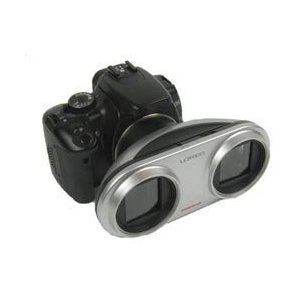


The stereoscopic 3D image above was captured with this Loreo 3D lens adapter which uses two focusing lenses to project two separate image views onto one camera frame.

What is your favorite 3D movie so far?


Thursday, April 26, 2012

The Power of Purls

Stereo image of John Wanamaker's department store in Philadelphia
Department store mogul and marketing pioneer John Wanamaker once expressed his frustration that "half my advertising is wasted, I just don’t know which half."


While Wanamaker passed away 90 years ago, his frustration lives on with everyone who manages or creates marketing campaigns.

On the web, we have many tools to track and measure the impact of our creativity. Pay per click advertising dashboards provide almost immediate feedback on the number of people who respond to an ad and Google Analytics allows us to track those prospects through our website. Those of us who blog or participate in social media conversations pay close attention to our reader statistics and comments. However, tracking the effectiveness of traditional advertising and direct mail is trickier.

Purls or Personalized Uniform Resource Locators are powerful tools for increasing response rates and tracking responses from direct mail pieces. These personalized URLs, which are printed in a prominent location on your mail piece lead your readers to personalized landing pages on the web which have been created individually for each recipient

Sample personalized landing page from Easy Purl
The software that we use for creating Purls at Convertible Solutions is called Easy Purl and the landing page to the right is a sample from their website. As you see, it welcomes Amy, explains why New York College would be a good choice and includes a form already filled in with her address information that provides a field where she can select her area of interest. It is very easy for her to click through to the next page which can collect more information. After Amy responds, a personalized thank you page is presented.

The Easy Purl software also includes a dashboard which allows the campaign manager to see which prospects have visited their page and what they did after seeing their page. This knowledge can identify where the offer or the creative design should be tweaked and if the mailing was sent to the correct list. The information can also be used to send triggered reminder emails to those who have not yet visited their page or visited without responding.


Browsing trends report created by Easy Purl

Marketing is still both an art and a science and tools can not take the place of a strong creative vision, but tools like PURLs combined with careful testing can be very helpful in determining how the customer feels about your message. John Wanamaker would be pleased.


Thursday, April 19, 2012

The Alpha and Omega of Modern Marketing


Before launching any multi-channel marketing campaign or jumping headfirst into social media marketing, you need to begin with a great website. In many cases, your website will be the first contact your customers have with your brand and the last contact they have before making a purchase.

Your website is the first solid contact that people have when they become prospects for your product and service. Whether they find you through a search engine or see one of your display ads, as soon as they become seriously interested, they will find your website to learn more about you. If you are a web retailer, your website is also the final step in their purchase process. However, even brick and mortar retailers have customers who use the web to do price comparisons, find store locations and check on store hours before coming into the store.

First impressions are important on the web. Your site needs to appeal to the type of customers that buy your product. The graphics and messaging need to pull people in and get them excited about your product and service. The navigation system should be balanced to help people find the right product with the minimum number of clicks.

If you want people to come back to your page regularly, the content needs to be frequently updated. A blog that covers topics that interest your customers is one of the best ways to keep people engaged with your site. The blog should be updated at least one per week and should not be used as a sales platform for the company's products. When you create a new blog post, be sure to mention it and provide links on all of your social media feeds.

Accessibility is extremely important. As more of your audience are shopping using smartphones and tablets, sites that don’t have mobile versions will get left behind. Avoiding Flash plugins is essential since iPhone and iPad users are not able to view them.

The final step is to make your website easily sharable. In addition to the buttons that allow people to find your pages on Facebook, Twitter, Pinterest and other sites, include buttons that allow people to share your content on their own feeds. And always make it very clear how people can subscribe to your content using an RSS reader or email.

Is your website all that it should be?


Thursday, April 12, 2012

Mizzou in 3D

University of Missouri sign

University of Missouri sign

Earlier this month, I asked my daughter Amy to help me find some of the best spots on the campus of the University of Missouri to capture some 3D stereo images. She completed her undergraduate studies at Mizzou and graduates from MU Law next month so she has spent the last seven years on campus.

As usual, I have uploaded each image as both a red/blue anaglyph and a stereo pair so you can choose your favorite 3D viewing method.

Amy and Truman at MU
Amy at one of the most iconic spots on the MU campus.

Amy and Truman at MU

The six columns on the quadrangle are probably the most recognized symbol of the University. They originally supported the portico of Academic hall, the first building on campus. Finished in 1843, the building was destroyed by a fire in 1892, but the columns have been retained. They were originally constructed from limestone from the nearby Hinkson Creek Valley.


The columns on the Mizzou quadrangle.

The columns on the Mizzou quadrangle.

The inscription on the George Lundeen sculpture of Thomas Jefferson reads: This bronze sculpture and garden were given to the University of Missouri-Columbia by trustees of the Jefferson Club to recognize the University's unique connection with Thomas Jefferson.  MU is the first Land Grant University in the Louisiana Purchase Territory, and the design of the Francis Quadrangle is modeled after the plan first used by Jefferson at the University of Virginia.

Thomas Jefferson statue on the quadrangle at MU.

Thomas Jefferson statue on the quadrangle at MU.

Jesse Hall is the main administration building for the University of Missouri and was built in 1893 after Academic Hall burned to the ground. It also houses Jesse Hall which is one of the best places in town to see concerts and plays.

The Dome of Jesse Hall at MU
The Dome of Jesse Hall.

The Dome of Jesse Hall at MU

Jesse Hall is the cultural center of the MU campus.

Jesse Hall is the cultural center of the MU campus.


Groundbreaking for the Memorial Union, which includes the A.P. Green Chapel, originally took place in November of 1921 as a tribute to the Mizzou alumni who died in the first World War. The Tower was completed in 1926 and the North Wing was completed in 1951. The South Wing was added in 1963. Amy says that her daily walk down the tree-lined path toward the Union is one of her favorite parts of living east of campus.


The Green Chapel at the University of Missouri.

The Green Chapel at the University of Missouri.

The Green Chapel at the University of Missouri.
The clock tower of Memorial Union seen over the roof of Green Chapel.

The Green Chapel at the University of Missouri.

Memorial Union at the Univeristy of Missouri
The tree lined path to Memorial Union

Memorial Union at the Univeristy of Missouri


Truman the Tiger, named after president Harry S. Truman, is the official mascot of the University of Missouri. He was formally named in 1986, but the use of a Bengal Tiger as the mascot dates back to the 1890s.

Truman the Tiger at MU
Truman the Tiger is the Missouri mascot.

Truman the Tiger at MU

Truman the Tiger at MU
A closeup of Truman the Tiger.

Truman the Tiger at MU

I don't know any of the history of this small pond near the edge of the campus, but these are some of the most beautiful 3D images that I have ever captured.

A quiet pond on the MU campus.

A quiet pond on the MU campus.

A quiet pond on the MU campus.
Another view of the pond at Mizzou.

A quiet pond on the MU campus.

How have you been enjoying your spring?


Thursday, April 5, 2012

A Tale of Two Offsets

HP Indigo Digital Offset Press


"It was the best of times, 

it was the worst of times... " 

Charles Dickens


March 22nd marked the ten year anniversary of the purchase of Indigo by Hewlett Packard which brought digital offset printing technology to a much larger market. During this decade, Indigo users have thrived while traditional offset printers have declined dramatically.

The contrast between the two printing technologies was very apparent in data presented by Alon Bar-Shany, Vice President and General Manager of HP Indigo, at this years Dscoop conference. Since 2006, print industry revenues have declined 49% from $108.5 billion to $55 billion. Large offset print campaigns have been replaced by small, carefully targeted campaigns and electronic publishing has eliminated the need for many printed documents.

However, Indigo digital offset page volumes have increased from nine billion in 2008 to twenty billion in 2012. The growth in short run printing, personalized marketing and personalized publishing have been a great opportunity for those who have embraced the digital technology.

Bar-Shany went on to announce a new family of HP digital presses that will challenge offset printing even more radically. The HP Indigo 10,000 is a 29" platform that can print a full eight page signature with the same seven color capability, automatic duplexing and multi-source feeder as the current Indigo line.

Printing and publishing have changed radically in the last decade and the pace of change is accelerating. How are you preparing for these changes?


Thursday, March 29, 2012

Creative Inspiration for The Hunger Games

Last weekend, the film The Hunger Games generated revenues of $155 million; a new record for a film which is not a sequel.  It places third for opening weekends overall,  behind last year’s “Harry Potter” finale and “The Dark Knight.”

Suzanne Collins, the author of the The Hunger Games, says that her inspiration came from channel surfing on television. The competition between contestants on a reality show and footage of the invasion of Iraq "began to blur in this very unsettling way" to form the main idea for the book. Throw in the Greek myth of Theseus and the Minotaur and Roman gladiatorial games and you have a recipe for a powerful series of books and movies.

This is a perfect formula for stimulating creativity. By combining a variety of experiences in a new way, something magic can happen.

What inspires your creativity?


Thursday, March 22, 2012

Multi-Channel Step by Step

Double Thick Impact Card by Convertible Solutions
Multi-channel marketing is one of the hottest topics in the printing industry. Marketers and printers have discovered that combining direct mail with electronic media produces better results than either do individually. Smart printers are leveraging this knowledge to drive printing sales and promote their marketing services departments.

A successful multi-channel campaign can be conducted in many ways. This posts outlines some of the steps that can be used to introduce a new product or concept.

1.  Seed Interest - Weeks or months before the introduction, start including links to articles that would be interesting to prospects in your social media feeds. This works particularly well in Twitter where the interesting articles are likely to be posted originally by potential prospects. Retweeting those posts can help you build a relationship with those prospects long before the product announcement.

2. Perfect Your Website - When you are ready to launch, make sure that your website is attractive, current and the product is easy to find and well explained. The prospect who visits your website needs to be persuaded to purchase and has to know how to purchase your product.

3.  Create a Compelling Mail Piece - Direct mail is one of the least filtered ways to reach your prospects. You need to create something that has visual and tactile impact so your customer stops and examines it as soon as they touch it. Convertible Solution’s Double Thick Impact Cards can help provide the tactile impact. Once the prospect is compelled to look at the piece, the graphics and the offer have to compel action.

4. Personalized Landing Pages - Include personalized URLs on your mailing that link to personalized landing pages. For example, www.David.Williams.Double-Thick.com* would link to a page that welcomes me by name, explains the offer concisely and allows me to respond to the offer by simply checking a box. The personalized landing pages simplify the response process for the prospect and provide tracking information to the marketer.

5. Mobile Website - Personalized QR codes can be included on the mailing that take people directly to their landing page when they scan the code with their smart phone or tablet. Non-personalized QR codes can be included on trade show signs, brochures and point-of-sale materials. Make sure that QR codes always direct people to a site that is designed to present the information clearly on a mobile screen.

6. Triggered Email - The software that creates the personalized URLs can also send emails based upon how people have responded.  A thank you email should be send to anyone who visits the site and responds to the offer and reminder emails can be sent at intervals to those who have not yet responded. The graphics and message in these triggered emails should stimulate the prospect’s memory of the original mailing.

7. Press Release - At the time of the launch, send a well drafted press release to the editors of the publications that serve your industry and post the release on a news service like PR Web or PR Wire. Be sure to also post it in the news section of your own web site. The release should include links to the product on your web site.

8. Social Media Sharing - Post links to the news story on your web site to your social media feeds. Be sure to express your appreciation to any followers who retweet or share your news and join in on the conversation. If anyone blogs about your product or creates any other original content about it, be sure to include links to those posts as well.

These are a few steps that can be used in the creation of a multi-channel marketing campaign. If you include video, pay per click, television or radio, make sure those messages also tie in with your print and web approach.

Have you completed a multi-channel campaign?  How did it go?


Double Thick Impact Card with Portal by Convertible Solutions


 *This link is no longer attached to a personalized landing page.