Tuesday, April 4, 2023

Art Against Aggression

Invasion by Thomas Hart Benton

Last week my wife and I visited the art gallery at the State Historical Society of Missouri for the first time. We were surprised and awed by the power of Thomas Hart Benton's World War II paintings.

As long time Missourians, we have seen Benton paintings in a number of locations including the large mural at the Missouri State capital. Many of his paintings, including those commissioned by the federal government as part of the New Deal, depict scenes of everyday life and celebrate the working class people who were the backbone of American society at the time.

The World War II paintings were different. More powerful emotionally.

These paintings were influenced by the social realism movement of the 1930s and intended to to modify American public opinion and rally public support for the war effort. To me, Invasion is the most powerful, depicting the violence of assault, murder, and rape that would likely result from a successful foreign invasion. The painting is a reminder of the horrors of war and the importance of remaining vigilant in the face of threats to national security.


Thomas Hart Benton Year of Peril
Starry Night

Inspired by the attach on Pearl Harbor and sponsored by Abbott Laboratories, Benton completed eight large paintings which are currently on display at the Historical Society in Columbia, Missouri. These were originally published in The Year of Peril propaganda pamphlet published by Abbott Laboratories and the U.S. Government in 1942.


Thomas Hart Benton The Sowers
The Sowers

Another important work on display is The Sowers which was created in 1943. This painting depicts a group of soldiers, sailors, and airmen marching across a barren landscape with a single figure in the foreground scattering seeds. The painting is a metaphor for the idea that the sacrifices made during the war would eventually lead to a better future.

Although these works were painted eighty years ago, their message is extremely relevant today. The Russian invasion of Ukraine and the attacks being made on the American liberties by state legislatures in Florida and other states remind us that still need to remain vigilant and fight Fascism in every form.

You might also like:

Adam Curtis at the True False Film Festival

Leaping the Great Firewall

The Revelation of Sonmi 451


This post was written with research assistance by ChatGPT

Friday, March 24, 2023

Viesus™ Announces Viesus Cloud Integration into Fiery™ JobFlow

Viesus Cloud, provider of an image enhancement and upscaling tool targeted at ensuring high quality large format printing, today announced its partnership with Fiery, LLC, providing seamless integration with Fiery JobFlow. Fiery is the industry’s leading Digital Front End (DFE) technology for production and industrial printing. The integration will provide users with access to advanced image enhancement and upscaling capabilities directly within Fiery JobFlow, a print automation software solution that automates labor-intensive prepress workflows to increase productivity, and reduce costs.

 By adding the Viesus Cloud integration, Fiery JobFlow users will be able to automate the process of enhancing and upscaling images for print, saving time and reducing manual clicks. This integration will also improve the overall print quality and consistency, especially for large format printing, where enlarging images can often result in reduced quality and artifacts. This integration benefits both print service providers and their customers.

Bird Image with JPEG Artifacts
The details in this image lack detail and show compression artifacts.

Image after enhancement with Viesus
After Viesus enhancement, the image has more detail and the artifacts are gone.

 "By integrating Viesus Cloud into Fiery JobFlow, we are offering our users the most advanced image enhancement and upscale tools available in the market," said Hans Sep, Product Line Manager at Fiery, LLC. "We are excited to provide our users with an intuitive, easy-to-use solution that will significantly improve their print quality and reduce manual effort as they work to meet their customers’ time and quality needs."

 Viesus Cloud offers a variety of advanced image enhancement capabilities, including automatic color correction, image sharpening, and noise reduction. These features are accessible directly from within Fiery JobFlow, making it easier for print service providers to achieve high-quality prints without the need for additional software or manual intervention.

 "Viesus is proud to be partnering with Fiery, LLC, to provide JobFlow users with access to our cutting-edge image enhancement technology," said Servi Pieters, Product Manager at Viesus. "Our technology, which uses AI-supported upscaling technology, is designed to optimize and enlarge images for print, making it a natural fit for Fiery JobFlow display graphics users. We look forward to seeing the benefits this integration will bring to print service providers and their customers as more of them adopt the Viesus solution for use with the Fiery workflow they are already comfortable with."

 The Viesus Cloud integration is available immediately as part of the latest Fiery JobFlow release. For more information, visit https://www.viesus.com/fiery-jobflow .

About Fiery, LLC:

 Fiery, LLC is the leading provider of digital front ends (DFEs) and workflow solutions for the industrial and graphic arts print industries. With a customer base of over 2 million DFEs sold globally, the company offers innovative software and cloud-based technologies that enable the fastest performance, the best color, and the highest print quality across a broad range of production printing devices. Fiery DFEs are installed in a diverse range of industry segments, including commercial print, packaging, signs and display graphics, ceramics, building materials, textiles and other specialty applications. With over 30 years of excellent support and service, Fiery has built an unmatched community of customers, dealers and partners.

 About Viesus Cloud:

 Viesus Cloud is a provider of advanced image enhancement technology, offering a range of solutions for print service providers, photographers, and e-commerce businesses. The company's cloud-based platform uses AI and machine learning to automatically optimize images for print and digital media.

You might also like:

Taming the Color Beast

The Future of Photography is Synthetic

iPhoneography in Near Darkness


Tuesday, March 22, 2022

No Mainstream Metaverse Soon

Woman wearing VR headset


Recent improvements and cost reductions in virtual reality headsets have led many people to believe that everyone will soon be wearing headsets every day and meeting up with their friends and coworkers in a virtual metaverse. I think that is highly unlikely for the following reasons:

Multi-tasking

Most people like to multi-task, particularly if they are participating in a meeting from home. It can be hard to participate in any way offline when fully immersed in a virtual reality experience. 

Mobility

This is closely related to the previous point. Almost all current video conferencing apps can be accessed on computers, tablets or phones. This allows people to use them anywhere. Driving to an appointment in a virtual reality headset would be the worst form of distracted driving.

Facial Expressions

The primary reason we prefer video calls over voice calls is the ability to see the faces and facial expressions of the people we are talking to. Conversing with a coworker's avatar is unlikely to be as rich of an experience.

Network Effects

Before it can go mainstream, any new communication tool must be adapted by a large percentage of the population. In 2019 and 2020, we were able to pivot from in-person meetings to virtual meetings quickly because the platforms worked using microphones and cameras in the computers and phones that we already owned. With the metaverse, a significant investment in new hardware will be required for every user. 

People will be reluctant to schedule metaverse meetings unless everyone invited has the hardware. People will be reluctant to buy the hardware until they start getting invitations to metaverse meetings. It is a cycle that is difficult to break.

What do you think? How soon do you think the metaverse will go mainstream?

You might also like:

Like 1992 Without the Supercomputers

What is Augmented Reality

Looking Forward


Note: This is the last regularly scheduled post for a while.


Tuesday, March 15, 2022

Nature is a Grand Material Engineer


Neri Oxman
Artist, Designer and Engineer, Neri Oxman by Noah Kalina

"Nature is a grand material engineer, we already know that it can generate abalone shells which are twice as strong as our high-tech ceramics and silk that is five times stronger than Steel."                                                                                Neri Oxman


MIT Media Lab Professor, Neri Oxman, and her students are committed to learning and applying the processes of nature to address the architectural challenges of the modern world. Their studies have included silk worms, bees, and plants to gain understanding in how nature grows structures. 

In addition to their structural relevance, the projects Oxman and her team have created are also beautiful works of art. Her work is part of the permanent collections a number of museums in the United States and Europe including the Museum of Modern Art and the San Francisco Museum of Modern Art.

Pneuma 2 by Neri Oxman
Pnuema 2 by Neri Oxman, Photo by John Cummings

In 2016, the group published a paper on a 3D Printed Multimaterial Microfluid Valve which provides better control in printing using fluid materials including molten glass. While it had been possible before to 3D print with glass by binding glass powder and subsequently sintering the powders, the results were not fully transparent. The MIT process provides structural control and full transparency.

3D Printed Glass by Neri Oxman

You might also like:


Tuesday, March 8, 2022

Heroes on the Russian Border

Vytautas Landsbergis (in the middle) on 11 March 1990, after the promulgation of the Act of the Re-Establishment of the State of Lithuania

Vytautas Landsbergis (in the middle) on 11 March 1990, after the promulgation of the Act of the Re-Establishment of the State of Lithuania.

Photographer Paulius Lileikis. Lithuanian Central State Archives


Last weekend, my wife an I attended the True/False documentary film festival in Columbia, Missouri. We have been attending True/False annually since 2011 and it is always the most enlightening event of our year. This year we saw eight full length films and ten shorts. Several were the first public showings of new films.

After each film, I turned my phone back on to check on the news from Ukraine. It is amazing that the Ukrainian people have been able to hold out this long against the Russian invasion and I believe that everyone who supports democracy and self determination admires the courage of the Ukrainian citizens and their president Volodymr Zelenskyy.

The four hour film we saw on Sunday morning was a reminder that Zelenskyy wasn't the first leader to show great courage on the borders of Russia. Mr. Landsbergis features Vytautas Landsbergis, the man who led the declaration of independence of Lithuania from the Soviet Union in March of 1990. The Soviet Union responded to the declaration with an economic blockade that failed. 

On January 11-13, 1991, the Soviet Union sent troops and tanks into the city of Vilnius to intimidate the Lithuanians into submission. The city was mostly defended by unarmed civilians, men and women, who stood up to the invasion. In some cases the tanks ran over civilians and the troops fired in the crowds. It was painful to watch knowing that the same thing was happening again in Ukraine while we were watching the film.

Unarmed Lithuanian citizen standing against a Soviet tank
Unarmed Lithuanian citizen standing against a Soviet tank. Photographer Andrius Petrulevičius.

Fortunately, in 1991, the revulsion of the rest of the world led Soviet President Gorbachev to withdraw the troops from Lithuania and a treaty signed by the new Russian Federation President Boris Yeltsin and Landsbergis formally recognized the independence of Lithuania. Let's hope something similar happens in Ukraine.

You might also like:

Adam Curtis at the True/False Film Festival

Leaping the Great Firewall

Creative Inspiration for the Hunger Games


Tuesday, March 1, 2022

Clarity on Freedom of Speech

Constitution of the United States
Constitution of the United States - U.S. National Archives

Last week, Russia's communications regulation agency announced that it would block websites that refer to the war in Ukraine as an "attack, invasion, or declaration of war." They are also targeting publications that mention the shelling of Ukrainian cities or civilian casualties. This is not surprising. Authoritarian regimes always tightly control the media to prevent their citizens from learning the truth. 

Freedom of the speech is one of the most important protections of a democratic society which is why it comes first in the United States Bill of rights. However, since the beginning of last year, there has been significant whining by people who should know better about violations of their right to free speech. Even people who have sworn to uphold the U.S. Constitution have apparently not actually read it. I believe it is helpful to clarify a few points about the First Amendment. 

Limits Only Governmental Action

The text of the First Amendment reads: Congress shall make no law respecting an establishment of religion, or prohibiting the free exercise thereof; or abridging the freedom of speech, or of the press, or the right of the people peaceably to assemble, and to petition the Government for a redress of grievances. 

This wording clearly limits only the power of the US Congress to limit free expression. However, subsequent Supreme Court cases, including Gitlow vs. New York in 1925, have incorporated the the language of the Fourteenth Amendment ("No state shall...deprive and person of life, liberty or property without due process of law") to apply the First Amendment restrictions to governments at the state and local levels.

Newspaper, book publishers, websites and social media platforms are not government agencies so they are not limited by the first amendment. When Twitter, Facebook and other site removed the accounts of the former President for violating their content rules, they were not violating his free speech rights.  In fact, they were exercising their own First Amendment right to edit their content responsibly.

Josh Hawley
Josh Hawley encouraging the protesters about to attack the Capital

Similarly, when Simon & Schuster decided not to publish Missouri Senator Josh Hawley's The Tyranny of Big Tech, they were not infringing his rights. They were simply making their free choice not to be associated with a repugnant individual. Hawley could and did find a different publisher with lower standards. 

Inciting or Producing Imminent Lawless Action

Others trying to misinterpret the U.S. Constitution are the members of the Oath Keepers and Proud Boys organizations that planned the January 6th, 2021 insurrection at the U.S. Capital. Supporters of these groups have claimed that what happened in Washington that day was "legitimate political discourse" protected by the First Amendment. The Supreme Court is unlikely to agree.

In Brandenburg vs. Ohio, in 1969, the Supreme Court ruled that "A state may not forbid speech advocating the use of force or unlawful conduct unless this advocacy is directed to inciting or producing imminent lawless action and likely to incite or produce such action." Since the encouragement of the Proud Boys and Oath Keepers, and probably Trump and Hawley, produced imminent lawless action, it falls clearly outside of the First Amendment protections.

You might also like:


Tuesday, February 22, 2022

The News Worth Reading


Front Page of the New York Times

After posting about Embracing the Inverted Pyramid, I was asked to provide examples of great news sources. Here are the sites that I browse daily.

  • The Wall Street Journal - A detailed source for business news in both the United States and Worldwide. 
  • The Columbia Missourian - This is my source for local news in Columbia Missouri and the University of Missouri. I believe everyone should subscribe to their local newspaper.
  • BBC News- The best English source that I have found for UK and world news. It also frequently reports events in the United States that are not covered elsewhere.
  • The Washington Post - Great investigative reporting and information about governmental and political topics.
  • The New York Times - A good source of US and world news and my favorite place to keep up-to-date on cultural themes.
  • The Economist - The Economist has a daily World in Brief which is an extremely concise and precise overview of world news. The Weekly Edition is an in depth analysis of world events and trends including the probable social and economic results of those events.

Most of these sources require a subscription, but the quality of the information is worth it. 

You might also like:

Enbrace the Inverted Pyramid

Stuck in the 20th Century

iPad 2 is Just Right


Tuesday, February 15, 2022

Embrace the Inverted Pyramid


The Inverted Pyramid
The Inverted Pyramid by the Air Force Departmental Publishing Office

Managing a business, allocating capital in a portfolio, or creating a personal development plan, all depend upon a reasonable forecast of future social and economic conditions. Keeping up-to-date on the current news is an essential part of forecasting. The challenge is following the news in a reasonable amount of time each day.

The secret to efficient news consumption is to seek out sources that employ the inverted pyramid style and include the most important information in the opening paragraph. Journalists are trained to include the who, what, why, when, where and how in the opening sentences. This allows the reader to grasp the most important news in a single glance and decide whether or not to read more. Since the online versions of most major newspapers display the headline and the opening sentence of each article on their home page, they make it easy to browse everything quickly.

When opening a story to learn more, the lead paragraph will be followed by other important details with the most important items first. As soon as you feel you understand the what you need, you can stop reading. The final paragraphs will be general and background material. In many cases, you will already be familiar with the background information and do not need to read it again.


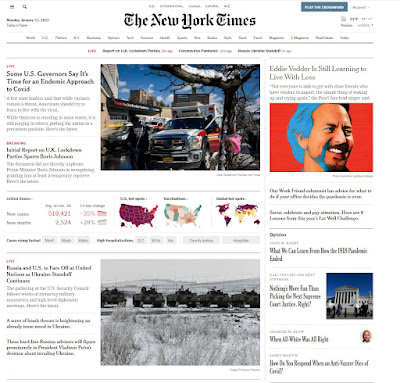
Front Page of the New York Times Online


The inverted pyramid style used by major newspapers is in stark contrast to the hook and delay process used by most television news broadcasts. These broadcasts start with a teaser that they will include an important insight later in the broadcast then proceed to something completely different. Continuing to watch will waiting for the insight generally results in a frustrating disappointment.

You might also like:

The Blogosphere and the Twitterverse

Stuck in the Twentieth Century

Find Something Interesting in People, Always!

Tuesday, February 8, 2022

Hoping to Hear Another Like Yasmin


Guitarist Jasmin Williams
Guitarist Yasmin Williams by Amr Alfiky/New York Times

In three weeks, my wife and I will be attending the True/False documentary film festival in Columbia, Missouri. It is the most fun and most enlightening weekend event we attend each year. The entire downtown becomes a celebration as filmmakers visit from around the world to screen their films and answer audience questions.

While the films are amazing, some of my favorite parts are the musicians who play before each screening. They are always an eclectic and enthusiastic group of young, not quite famous yet, artists with a variety of new and unique approaches to sound.

Last year, and the year before, we greatly enjoyed listening to Yasmin Williams. She plays solo guitar expressively in a style which combines elements of folk, flamenco, and classical guitar. Words don't do the music justice, so watch the video. 


Yasmin won't be playing at True/False this year. We are hoping to discover some other new talents that we will enjoy just as much.

You might also like: 

Adam Curtis at the True False Film Festival

Leaping the Great Firewall

The Impossible Movie

Tuesday, February 1, 2022

No Beauty Without Strangeness

Dakoto Fanning by Karl Lagerfeld
Dakota Fanning by Karl Lagerfeld for Harpers Bazaar


"I don't like standard beauty - there is no beauty without strangeness"    Karl Lagerfeld

Fashion Design and Photography have always traveled hand-in-hand. Rarely have both skills been combined in the same individual as they were in Karl Lagerfeld. As Creative Director of Chanel from 1983 until his death in 2019, he revitalized the brand originally created by Coco Chanel and brought it forward into the 21st century. 

In addition to his role in fashion design, Lagerfeld was also responsible for Chanel's publicity shots each season. He developed a unique, avante-garde, style which make his iconic images instantly recognizable. The images below were featured in different issues of Harpers Bazaar magazine.

Candice Swanepoel by Karl Lagerfeld


Rosie Huntington-Whiteley by Karl Lagerfeld


Gigi Hadid by Karl Lagerfeld

You might also like:


Tuesday, January 25, 2022

Yes is More

Copenhill Waste-to-Energy Plant
Copenhill Waste-to-Energy Plant, Image from BIG

On December 6th of 2021, BIG's CopenHill Amager Bakke project was named World Building of the Year at the World Architecture Festival. The project exhibits BIG founder Bjork Ingels' philosophy of hedonistic sustainability by combining a power plant project with a ski slope, hiking trail and climbing wall.

Ingels points out that architecture often varies between two opposing extremes; "an avant-garde full of crazy ideas, originating from philosophy or mysticism; and the well organized corporate consultants that build predictable and boring boxes of high standard." Ingels and his firm focus on a third way which they describe as "a pragmatic utopian architecture that creates socially, economically and environmentally perfect places as a practical objective."

One of my favorite of Ingels' projects is the 82 foot-high Mountain Dwellings built in the Orestad district of Copenhagen. By arranging apartments in a diagonally sloping scheme, the mountain themed complex provides spacious apartments with each including a 1000 square foot south-facing terrace. After completion in 2008, it received several prestigious awards including the World Architecture Festival Housing Award,

Mountain Dwellings
Mountain Dwellings, Image by BIG

You might also like:


Tuesday, January 18, 2022

Two Historical "Greats"


Grand Duchess Catherine Alexeevna by L.Caravaque

I have just finished reading two fascinating biographies of monarchs so respected by their subjects and the world that they have been proclaimed with the title "The Great." Emperor Peter the First and Empress Catherine the Second, who led Russia during 18th century Russia transformed their country in ways that prepared it for the modern world and greatly improved the standard of living of its citizens.

Both were autocratic monarchs as were the leaders of almost all countries at the time. Both were also successful military strategists that enlarged the Russian empire and made the borders of their country more secure.  But those are not the traits that earned them their claim to greatness.

Both Peter, and Catherine two generations later, were declared great because of their intellectual curiosity, willingness to bring experts and expertise from around the world to Russia, and the enthusiasm to use those ideas to transform their country.

Peter the First by Jean-Marc Nattier

Peter was raised in a mostly medieval society, reluctant to embrace any new ideas and under strict control of an extremely conservative Orthodox Church. Early in his life, he realized that breaking Russia's isolationism would require a navy and he traveled to the Netherlands to personally learn the art of ship building. He also selected intellectually curious Russians to travel to all of the major capitals of Europe and learn the state-of-the-art methods for manufacturing and governance. When they encountered exceptional teachers, they persuaded them to come back with them to Russia to assist in the country's transformation. Included in the immigrants to Russia were the great architects who built the beautiful city of St. Petersburg. 

Catherine was a child of the enlightenment who read and corresponded with French and Swiss philosophers like Voltaire, Diderot, and Rousseau. She also traveled throughout Russia and listened patiently to the concerns of the Russian nobility and the Russian Serfs. Catherine brought European political and judicial processes to Russia along with literature, art, architecture and medicine. She built hospitals, schools and orphanages while assembling the greatest art gallery in Europe. She even persuaded her citizens to be inoculated against smallpox.

If intellectual curiosity and openness to new ideas is the hallmark of greatness, we need to ask what our leaders have been doing in the 20th century that could be classified as great. Regardless of political party, the restrictions on travel, low limits on H-1B visas, and attacks on freedom of speech indicate our leaders appear to be governed mostly by fear; fear of terrorists, fear of infection, fear of people willing to study harder or work harder.

If we truly want to reach our greatest potential, we need to open our minds to new ideas and our country to those who can help us implement new ideas.

You might also like:

Diverse Experience Drives Creativity

Collisions of Ideas

Good Enough or Great Enough


Tuesday, January 11, 2022

Good Grief


Call Us What We Carry

Since listening to Amanda Gorman read her poem, The Hill We Climb, during President Biden's inauguration, I have been eagerly waiting for her to publish a book with more of her poems. Her book, Call Us What we Carry, was released late last year and I had an opportunity to read it during the holidays.

The poetry focuses intensely on the emotional experience of living through the Covid 19 pandemic. It addresses the fears, stress, and feelings of loss over the last two years. Even those who did not lose loved ones lost the ability to spend time with loved ones and lost the normality of their previous lives.

It is also a book full of hope, recognizing that the experience has changed us in powerful ways. One of my favorites is titled Good Grief and here are a few excerpts:


The hurt is how we know

We are alive & awake;

It clears us for all the exquisite,

Excruciating enormities to come.

We are pierced new by the turning 

Forward.


All that is grave need

Not be a burden, an anguish.

Call it, instead, an anchor,

Grief grounding us in its sea.


We are built up again

By what we 

Build/find/see/say/remember/know.


You might also like:

The Revelation of Somni 451

Closer to the Heart

Find Something Interesting in People, Always


Tuesday, January 4, 2022

Technology Trends for 2022


2022 Kia EV6
 Kia EV6 launching early 2022


The start of a new year is always an exciting time to consider the technologies that will receive the greatest attention and have the greatest impact in the upcoming months. Here are a few of the top trends for 2022.

Energy Storage

This will be a year of significant investment in battery manufacturing and improvements in design to reduce costs and increase vehicle range. Expect to see announcements about solid state battery designs and substitution of some lithium components with other materials including nickle and silicon. These developments will help drive growth in electric vehicles and wearables.

Electrification of Transportation

This will be a year of growing market share in new vehicles with electric or hybrid drive trains. This will be influenced by the advances in energy storage listed above as well as improvements in energy harvesting, electric motors and use of advanced materials and in-mold electronics to reduce vehicle weight. Several new models will be introduced through the year and even more in early 2023.

Artificial Intelligence in Engineering

Expanded and more sophisticated uses of artificial intelligence in design will lead to faster development of pharmaceuticals, more interactive web stores and weight reduction in automotive and aeronautic applications. Generative AI combined with improvements in additive manufacturing is particularly promising for enabling the early electrification of small aircraft. Artificial intelligence will also play an increasing role in the photographic industry.

Keep an eye on these trends as you allocate your research time and investment plans for the upcoming year.

You might also like:

Do Your Own Annual Review

Make a Not-to do List

Top Tech Stories of 2015


Tuesday, December 21, 2021

Attaching the Cover to the Book

In this closing article in this series on book assembly, the covers (cases) and book blocks discussed in the previous articles are brought together in the process called casing-in. In this step, glue is applied to the outside of the front and back of the book block. The book block is placed inside the cover and aligned so that the cover overhangs the block evenly at the top, bottom and front. Then the book is placed under pressure until the adhesive sets.

Praleg Casing-in Machine by Schmedt
PraLeg Casing-in Machine by Schmedt

While it is possible to do the casing-in step by hand, and many small book and album companies do, most book plants use some type of automated machinery. The semi automated PraLeg by Schmedt is a good machine to discuss because it is easy to see and understand its operation.
First, the book block is placed over the wing that sticks out at the top of machine. The machines lowers the book into glue area and the cover is placed face up on top of the machine. Then the machine raises the book block through rollers that apply the glue and lifts the block into the cover.


PraForm by Schmedt
PraForm by Schmedt

Once the cover is attached, the assembled book needs to be pressed and the hinge needs to be formed. The picture at the right shows a book ready to be pressed in a Schmedt PraForm.


The video below shows these steps much more clearly than I can describe them. 


The Schmedt machines are used in a wide variety of moderate volume book companies. Muller Martini and other companies make bigger, faster and more automated machines, but internally their function is very similar to the PraLeg.

You might also like:


Automated Casing-In Machine by Muller Martini


The offices of the Creativity Paradox will be closed between Christmas and New Year's.  Look for the next post on Tuesday, January 4th.


Tuesday, December 14, 2021

The Case for Hard Cover Books


Hard Cover Book

I spend a lot of time reading and most of it is on the screen of my computer, iPad or phone. But when I am strongly interested in the visual content of a book, I insist on a hard cover book, preferable layflat or Smyth bound. It is far easier and more enjoyable to explore photography, art and architecture in a real book.

In the printing industry, the term for the cover of a book is the case and most cases are made in the same way. Cardboard reinforcements, slightly larger than the book block, are cut for the front, back and spine of the book. They are glued to the back of the cover material which is then wrapped around the edges of the cardboard and tucked in at the corners.

The PraDeka XL from Schmedt is a semi-automated case making machine that works well for moderate volume personalized book manufacturing. As you can see in the picture at the right, the cover, with adhesive on the back, is placed face down on the machines vacuum table and the cardboard is place within the alignment guides. Pressing a footswitch pulls the cover into the turning section which wraps the top and bottom edges. After tucking in the corners by hand, the operator turns the book 90 degrees and presses the footswitch again to wrap the left and right edges.

This is easier to demonstrate than to explain and the video below from Schmedt's YouTube channel is very easy to understand.


While Schmedt builds a range of different equipment for bookmaking, higher volume book binding companies use more automated machines supplied by GP2, Kolbus, and Muller Martini.

You might also like:


Monday, December 6, 2021

Taming the Color Beast

 Calibration, Characterization, and Enhancement

Colorful Dragon

To the uninitiated, getting consistent, predictable and pleasing color from a printer or a press can feel like taming a wild beast. The interactions of calibrations, characterizations and individual image characteristics provide a wilderness of complexity where it easy to get lost. However, an organized, step-by-step, process can provide a roadmap through the wilderness to the paradise of perfect color reproduction.

Calibration

Calibration is the first step. Calibration is the process of adjusting an individual device to produce the individual colors at the levels intended by the manufacturer. This is done by printing a target consisting of a simple pattern of patches of increasing density. The Creo target shown below is a very common type of target for a CMYK device.


Each patch on the printed calibration target is measured with a densitometer, a device that measures the amount of light reflected from the surface of the paper. The calibration values are fed back into the printer so it can adjust the exposure or ink levels bringing the printer into calibration.

Because calibrations can be impacted by a wide variety of items including variations in ink viscosity, paper absorbency, temperature, and humidity, they should be checked frequently.  Photographic printers should be checked several times per day. In a large offset print run, press sheets should be pulled and evaluated several times per hour. On the most sophisticated digital presses, a calibration strip is included on each sheet and each sheet is measured automatically.

Characterization

Characterization is often called profiling and provides the information about the way a device reproduces color including the breadth or gamut of color that is possible from the device. The resulting profile is used by the Color Management Module to provide the most accurate reproduction of color possible from the device. Proper characterization will allow images to be reproduced as consistently as possible across multiple devices and paper substrates.

To create a color profile, an IT8 color target, as shown below, should be printed on a fully calibrated printer. This target consists of 24 grey patches and 256 color patches which have been precisely defined by the American National Standards Institute. Each patch must be read by a spectrophotometer, a device which measures the reflectance of light across a wide spectrum of wavelengths. These values are fed into the software which creates the profile.

IT8 Target
IT8 Target by Hugo Rodriguez

Usually, a separate profile is required for each paper type on each output device, but the profiles can be used for as long as the device and substrate continue to be used together.

Image Enhancement

Once a color system is calibrated and characterized, the characteristics of individual images come into play. No camera system that currently exists can capture, and no printing system can reproduce, the full dynamic range of human vision. Image enhancement is required to adjust the colors in the image so the reproduction comes as close as possible to matching the human perception of the original scene. Some enhancements are global meaning they are applied to the image. Others are local, applied only to specific areas of images.

Professional photographers often enhance their images manually using tools in Adobe Lightroom or Photoshop. Higher volume image companies, including consumer photo companies and web retailers need tools which can automatically analyze and enhance images without human intervention.

One of the best tools for automatic image enhancement is Viesus, from Image Solutions. Automatic global enhancements in Viesus include color, brightness, contrast, sharpening, and noise reduction. Local enhancements include local brightness to lighten the foreground of backlit images or areas in deep shadows; sharpening of hair, eyebrows, and foliage; noise reduction on skies and skin; and specific color correction of skin, sky and grass.


This image lacks brightness and the colors seem muted and dead.


The same image after Viesus enhancement has a brighter face, sharper leaves and hair, and a livelier shade of green in the trees.


You might also like.

November in Columbia

You Would Even Say it Glows

How to View Stereo 3D Content


This post has also been published on the blog at Viesus.com.


Tuesday, November 30, 2021

The Cover is Not the Book


The cover is not the book
Image from Burleson Public Library

The first thing you see when you pick up a book is the cover. However, it is the inside of the book, the book block, which has a far greater impact on the overall functionality of the book. In this post, we are going to cover three book block construction methods and their advantages and disadvantages.

Layflat binding is a premium quality technique which is used for books with a strong visual impact. The most common applications are photo books, children's books and sales collateral for high end real estate and yachts. A layflat book consists of series of panoramic two-page spreads without any gutter or break in the center.

Image from Imaging Solutions AG

The two images above show the contrast between a perfect bound book where the image is interrupted by the gutter at the center and the layflat book at the bottom where the image can stretch seamlessly across the center.

Layflat books are manufactured by printing each two page spread, leaving the back of each printed sheet blank. The printed sheets are creased and folded at the center then glued together back-to-back or with a cardboard sheet sandwiched between to create thicker pages.

fastBook Professional by Imaging Solutions AG

Most personalized layflat books are made using equipment from Imaging Solutions AG in Switzerland. The fastBlock and fastBook Professional take the printed and collated sheets and do the creasing, folding and gluing to create a book block ready for trimming.

While layflat books have strong visual impact and are extremely durable, they require twice as much paper as other types of books and the binding process is slower because each page is glued individually. They are too expensive for most mainstream book projects.


Smyth Sewn Book
Smyth Sewing Produces Durable Books for Libraries

Most library books and textbooks are bound using Smyth Sewing. A Smyth sewn book is manufactured by printing the content on both sides of a large sheet. These sheets are folded to create signatures consisting of multiple pages, often 16 or 24 pages per signature. Each signature is sewn with thread through multiple places along the spine of the book. Then all of the signatures are sewn together to create the complete book block.

Smyth book sewing machine
Smyth Machinery USA Provides equipment for Smyth Sewing

Automated equipment for building Smyth sewn books was first patented by David McConnell Smyth in 1871 and the company which bears his name is still one of the leading suppliers of Smyth sewing equipment. Because the threads go through every page, these books are durable and hold up well to heavy use. However, the process works best for large runs of books and is seldom used for personalized book projects.

The most popular from of book binding is perfect binding which is used for almost all paperback books and many inexpensive hard cover books. In a perfect bound book, the pages are printed on both sides and trimmed to a single page size. The pages are collated together and the spinal edge is roughed up with blades or abrasives. Next an EVA (Ethylene Vinyl Acetate) hotmelt glue is applied to the spine and the spine of the book block is pressed into the spine of the soft cover. As the glue cools, it holds the pages together and holds the cover to the book block. 

If the perfect bound block is to be used in a hardback book, stronger end papers are added at the front and back of the book before it is glued. These will be used to attach the book block to the cover.

Standard Horizon Perfect Binding Machine
A perfect binding machine from Standard Horizon.


Many companies make perfect binding equipment including Standard Horizon, Mueller Martini and CP Bourg

Perfect bound books are popular because they are lightweight and inexpensive to make. However, the glue in the spines keeps the books from opening flat. If the books are forced open, the spine can be broken and the pages can fall out. Heavy use can also cause the spines to give way and allow the pages to fall out. While this binding method is often used for personalized books, the books lack the durability and the visual impact of layflat books.

There is a variation of perfect binding called PUR binding. With PUR, the EVA hotmelt adhesive is replaced with a Polyurethane Reactive adhesive. This is stronger and makes the pages less likely to fall out, but it also requires several hours of curing time before the book can be trimmed. This makes it less attractive for manufacturing personalized books.

Whichever of these binding methods are used, the final book block must be trimmed on the top, bottom and front edge before it can be cased in.

You might also like: