Showing posts with label Computational Imaging. Show all posts

Tuesday, November 16, 2021

The Future of Photography is Synthetic

Zerolens User Interface
 
A commercial photo shoot has traditionally been a complicated process. You needed the product, props, a set designer, lighting and a skilled professional photographer. Apparently, all of those things can now be synthesized in a browser based virtual design studio from Zerolens.

In a presentation at Virtual 1st last month, Nik Redl, Co-founder and CEO of Zerolens, explained how their site can be used with 3D product models to allow the creation of photo-realistic product shots in less than three minutes. The site is preloaded with a library of  customizable 3D models and they can build models of your products in a few days.

Zerolens recommends their tools to create images for e-commerce, social media and A/B testing. By simplifying the process of creating images, it should be possible to create a much wider variety of images for specific use cases.

In a conference filled with exciting photographic applications for artificial intelligence, Zerolens stood out enough to win the Best in Show Award.

You might also like:


Thursday, October 15, 2015

Cameras of the Future

Light L16 Camera
Historically, there has been a direct relationship between the size of a camera and the quality of the images that it can capture. Sharper, brighter images were the result of larger lenses to collect light and larger sensors to convert that light to a digital image. Computational imaging ends that relationship.

The L16 is a new camera from Light that packs 16 individual 13 megapixel sensors with three different focal lengths into a size slightly larger than a smartphone. Five of the sensors have a 35mm lens, five have a 70mm lens and six have a 150mm lens. By capturing ten images, simultaneously, at the different focal lengths and different locations on the camera, the device collects data that can be computed into a 52 megapixel image.

While the L16 provides the resolution of a high quality DLSR in a much smaller package, at $1699 the price seems a bit steep to cause many people to rush out and replace their existing DLSR.  However, as the technology progresses and comes down in price, I believe this will be the way most new cameras will be designed.

Light is also working with phone manufacturers to bring the technology into smartphones by late next year.

You might also like:
Cellphone Array Camera 
Every Image Possible
The First Portrait Lens 


Wednesday, July 24, 2013

Capturing More with Less

Positive Lens by DrBob via Wikimedia Commons
Image by DrBob via Wikimedia Commons
Soon we will all be able to capture beautiful high definition images with the camera on the edge of our iWatch.  That's my vision of the future of imaging after listening to a paper on High Quality Computational Imaging Through Simple Lenses presented by researchers from the University of British Columbia.  The paper was part of a session on Computational Light Capture at the SIGGRAPH conference this week.

The paper, prepared by Felix Heide, Mushfiqur Rouf, Matthias Hullen, Bjorn Labitzke, Wolfgang Heidrich and Andreas Kolb, observes that modern camera optics are complex, heavy and expensive to compensate for the geometric and chromatic aberrations of a single lens. The paper proposes a method to remove the artifacts through a set of computational techniques.

Considering how much the iPhone and Instagram have influenced photography over the last few years, it is fascinating to imagine the impact of capturing perfect images with a single element lens.

Will you be selling your lenses soon?

You might also like:
Cellphone Array Camera
It's About Time
Every Image Possible


Thursday, August 30, 2012

It's About Time!

Femto Photography can capture the motion of light.
Since the introduction of digital photography, researchers have focused on increasing spatial resolution. With more megapixels of data from the sensor, a camera can better simulate the human optical system. Today, when every smart phone has a high resolution sensor, researchers are moving beyond resolution and capturing images that explore other dimensions.  One of the new dimensions discussed at SIGGRAPH this month was time.

Ramesh Raskar and a team of scientists at MIT have developed Femto Photography, a method to capture images with an exposure of a trillionth of a second. This capture is fast enough to track the propagation of light through a scene.  When a series of these frames are assembled into a slow motion video, we can actually see the path of the light.

One of the interesting potential applications for Femto-Photography is medical imaging. As light travels into a semi-transparent surface, like human skin, the light scatters beneath the surface and some of it reflects back in the direction of the camera. Analysis of this sub-surface scattering could reveal the composition of the tissue below the surface.

The method can also be used to see around corners. Light which bounces off of a door into a room will travel different distances to each of the items in the room. By comparing the times when the photons bounce back to the camera, the positions of everything in the room can be computed.

Time is just one of many new dimensions that can be explored using computational imaging. What would you like to see?


Ramesh Raskar explains Femto Photograhy at TED 2012

You might also be interested in:


Wednesday, August 24, 2011

Cellphone Array Camera

Question:  What is the best camera for taking a picture?

Answer: The one you have with you!

 Since most of us carry our cellphone with us all the time, cellphone cameras have been quickly overtaking other imaging devices. Infotrends reports that 42% of people with a camera phone use it as their primary camera.

Although the resolution of camera phones has been steadily increasing, they have remained limited in their ability to capture pictures in low light situations or zoom in well on distant subjects.  These capabilities required large lenses which don't fit into a camera phone. This is about to change.

Mountain View, California based Pelican Imaging Corporation has built a prototype of an array of 25 cameras that can easily fit into a smartphone. With 25 imaging sensors, far more light can be captured, greatly improving the performance in low light conditions. The data from all the individual sensors can be combined to compute an image far sharper and with a greater dynamic range than any single sensor could produce.

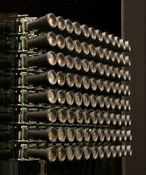
A large array of cameras for research at Stanford University
Since the images are being captured from different angles, it would also be easy to compute a pair of stereo 3D images or a set of multiple views for lenticular 3D prints. 

The limitations of  the current camera phones are part of the reason why serious photography enthusiasts still buy digital single lens reflex cameras, micro four thirds systems and other high end image capture tools. These limitations also help preserve the market for professional photography by preventing the average camera phone user from capturing a great image.

The reduction of quality differences between consumer cameras and professional cameras have been already changed the professional photography market significantly. The introduction of array cameras on cellphones will accelerate that trend.

What is your favorite image capture device?