Thursday, March 26, 2015

I Prefer Reading e-Books

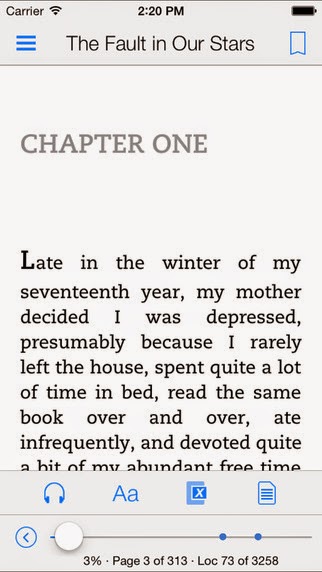
Since I work in the printing industry, I see and sometimes share articles that explain why people prefer reading printed books over e-books. At the risk of angering my colleagues, I do not actually hold that opinion.

 I have been an avid reader from a very early age and worked in a library as a teen. My office at home is lined with bookcases full of books and we often keep books of photography on the coffee table.  I even work for a company that makes photo books. So I appreciate the artistic value of a well made book. 

When I am reading though, I prefer my iPad. When I have the luxury of curling up to read in my favorite chair at home, the form of the book doesn't matter.  But I do much of my reading while traveling. This includes airplanes, restuarants and hotel rooms. Here are the reasons that the iPad is a better tool in those environments:

Weight


 Most single books are heavier than a modern tablet, but a trip of any length presents an opportunity to read several books. Carrying a book for the flight out, one for the hotel and a third for the trip home adds up to a lot of weight.

Size


Many books that I want to read are only available in hardback versions which can seem huge in tight spaces. Airplane trays are not very wide and it can be a struggle to coordinate a book and a cup of coffee on the tray at the same time. In restuarants, single diners are often assigned to narrow tables without room for both a book and a plate.

Lighting 


Fine dining is usually accompanied by low light levels and hotels don't always position lamps and chairs in a way that provides good light for reading. This is exacerbated by the fact that a book has left and right pages. To keep each page in the best light, the book has to be shifted back and forth on each page change. The iPad provides its own light and allows me to position it and scale the text size to best fit the space available.

 While I have seen the references to studies that appear to show a higher comprehension level when reading a printed book, I don't feel that it makes any difference to me. I don't detect any difference in the amount of content that I remember whether the content comes from a printed book, an e-book or an audio book. After a short time has passed, I don't even think about how I "read" the book.

The argument that e-book readers are more easily distracted seems like a red herring. I have an iPhone with me at all times and it is just as easy to close a printed book and check email or Facebook as it is to close the Kindle app to check those things.

Do you prefer printed or electronic books?

You might also like:

Saturday, March 14, 2015

Adam Curtis at the True False Film Festival

Once a year, Terri and I spend an intense and mind expanding weekend watching documentary films at the True False Film Festival. This year, our film choices included over six hours of fascinating content by the British filmmaker Adam Curtis.

With my background in marketing, I was particularly amused by The Century of Self which explores how the theories of Sigmund Freud and his predecessors in the field of psychoanalysis were adapted by corporations and eventually governments to influence purchasing and voting behavior.

The Century of Self predicts that politicians who target our irrational, primitive impulses rather than appealing to our rational, conscious minds will devolve democracy into a system where narrow self-interests are all that matter. In the thirteen years that have passed since the release of the film, that prediction has proven to be remarkably accurate.

Adam Curtis
Filmmaker Adam Curtis in 2005
We also saw a new film by Curtis. Bitterlake explores the experience of Western governments in Afghanistan since the end of the Second World War. It argues that the world, particularly the Middle East, is more complex than Western policy makers want to believe. The simple narratives that we tell ourselves lead to the failed and destructive policies which are implemented.

The title of the film comes from the 1945 meeting of Franklin D. Roosevelt and King Abdulaziz of Saudi Arabia, on a ship in the Great Bitter Lake on the Suez Canal. Agreements made at the meeting laid the groundwork for much of what has happened in the region since.

You might also like:
Leaping the Great Firewall
Print the Legend Highlight the Drama of Entrepreneurship
The Impossible Movie


Print the Legend Highlights the Drama of Entrepreneurship

Print the Legend
While many people admire and envy the entrepreneurs who start successful companies, few can envision the reality of building a company while under pressure from investors, customers and competitors. Print the Legend, a Netflix original documentary, highlights those challenges clearly as it tracks the creation of the 3D printing companies Makerbot and Formlabs.

Makerbot's Bre Pettis and Formlab's Max Lobovsky have dramatically different personalities, but they faced similar pressures as their companies grew and both had to make difficult decisions about people, policies and partners as they moved from the startup phase into full production mode. Print the Legend follows this progression and highlights both the drama and the impact of those decisions.

As I have written frequent in this blog, I believe that 3D printing is one of the most important technologies impacting manufacturing. That's what drew me to watch this movie on the day it was released. After seeing it, I recommend it to anyone who is interested in entrepreneurship, regardless of their interest in 3D printing.

What is your favorite movie about entrepreneurship?


You might also like:
Hugo, Visually Stunning 3D
The Impossible Movie
Create Your MVP


Thursday, March 12, 2015

Walter Arnold and the Art of Abandonment

The Final View by Walter Arnold
Last week, during the WPPI convention in Las Vegas, I met a brilliant photographic artist with an unusual body of work. In his Art of Abandonment series, Walter Arnold has captured the beauty of sites that have been abandoned and neglected. By using high dynamic range photography and printing exclusively on aluminum, he creates prints that have an intense saturation and an almost eerie feeling.

Arnold's initial inspiration for the Art of Abandonment was an airplane graveyard in St. Augustine, Florida that he discover in 2009.  Other sites in the series include Grossinger's Resort in the Catskills of New York, The Scranton Lace Company in Scranton, Pennsylvania and the Tennessee Brewery in Memphis, Tennessee.

For the last five years, Arnold has used Black River Imaging to produce the metal prints that he sells at art festivals and galleries.  In his presentation at WPPI, he pointed out that he has his images printed on metal because it provides "astounding depth and dimension.

Check out Walter Arnold's unique images at www.artofabandonment.com where his blog highlights the images and the stories behind the images.

You might also like:
Wide and Wonderful
In Vino Veritas
Postcards from the Netherlands


Saturday, February 28, 2015

Thin Film Electronics Gains Momentum

OpenSense from Thin Film Electronics
Thin Film Electronics, the printed electronics company based in Oslo, Norway, is poised to benefit greatly from the Internet of Everything. Since I first wrote about the company in September, several important news items show that the company is rapidly gaining momentum.
  • Revenue Growth - Revenues for the 2014 full year grew 121% over the 2013 full year.
  • Large Orders - After shipping it's first order with a 7 digit unit quantity last year, the company has a new 13 million unit order for its Electronic Article Surveillance labels.  
  • Partnerships -The company has announced a strategic partnership with Xerox for the high-volume production and sales of Thinfilm Memory labels. This will reduce future capital requirements by leveraging Xerox manufacturing resources.
  • NFC for Bottles - OpenSense™, a near field communication sensor for bottles, is a new product improves product security and enhances consumer engagement. Now your smartphone will be able to talk to your bottle of Johnnie Walker scotch.
  • Listing on Oslo Børs - On February 27th, shares of Thin Film Electronics were listed on the Oslo Børs and a registration has been filed for an American Depositary Receipt program in the United States. This will increase the company's visibility and widen the investor base.
Each of these represent an important breakthrough. Together, they appear to be significant momentum.  I will be watching this company closely with high expectations.

What would you like your scotch to say to you?

You might also like:
Apple NFC and Thin Film Electronics
Top Tech Stories of 2015
Looking Forward


Thursday, February 26, 2015

Your Personal Moat

Bodiam Castle, a 14th-century castle near Robertsbridge in East Sussex, England

Last week we explored the ways that businesses can build an economic moat to provide protection from competition. I believe that it is also possible to build a personal moat that provides a buffer against the challenges we face individually.

Some of the key elements of a personal moat include:
  • Knowledge - Information is power. If you have knowledge and understanding of important concepts in a field that is in demand, you can use that knowledge to navigate through the channels of change.
  • Skills - Skills represent your ability to harness knowledge to accomplish specific goals. People who can get things done are always in demand.
  • Creativity - Creativity is the ability to synthesize ideas from multiple sources into a new idea or a new solution to a problem. 
  • Relationships - It's not just who you know. It's how you have treated them and how they feel toward you. Treat everyone you meet with respect and kindness.
  • Resiliency - We all have difficult days, even difficult years or decades. But the only hope of success is to keep pushing forward with new attempts and new strategies to succeed. In the darkest days of World War II, Winston Churchill told the world "If you are going through hell, keep on going!"
With the rate of change accelerating rapidly, the value of a personal moat grows everyday.

What are you doing to enhance your moat?

You might also like:
Choose the Difficult Assignment
Creating Happiness
An Arrogant Assumption


Thursday, February 19, 2015

Build Yourself a Moat


Image of Baddesley Clinton from Museo8bits
The moated manor house of Baddesley Clinton in Warwickshire, England
In the ancient and medieval periods, cities and castles were often built with moats to protect them from outside enemies.  These deep trenches were built next to the outer walls and often filled with water to make it more difficult to reach and breach the walls.

The metaphor of moat building is often applied to business. In 1999, Warren Buffet pointed out that “The key to investing is . . . determining the competitive advantage of any given company and, above all, the durability of that advantage. The products or services that have wide, sustainable moats around them are the ones that deliver rewards to investors.”  Those moats protect the company from excessive competition and allow them to provide above market rates of return.

In their 2014 book, Why Moats Matter, Heather Brilliant and Elizabeth Collins identify five major sources of competitive advantage or economic moat:
  • Intangible Assets include brands, patents or licenses that limit the ability of other companies to compete against you.
  • Cost advantages allow you to provide your products or services at a lower cost than your competitors.
  • Switching costs are the inconveniences or expenses a customer will incur to move from your company to a competitor. 
  • Network effects cause the value to of your products or services to expand as more people use them.
  • Efficient scale is a situation where a market has a size limitation that discourages competition.
Why Moats Matter book coverAs business people, we need to find ways to build these types of moats around our businesses.  As investors, we need to seek out and buy companies that have strong and increasing competitive moats already in place.

What type of moat are you building?

You might also like:
When Your Name Becomes an Adjective
The Benefits of Going Nowhere
The IDE3A Process